Rise of Nations Ideology Guide
Wings, tier paths, State Doctrine laws, Liberation flips, and regime-change projects.
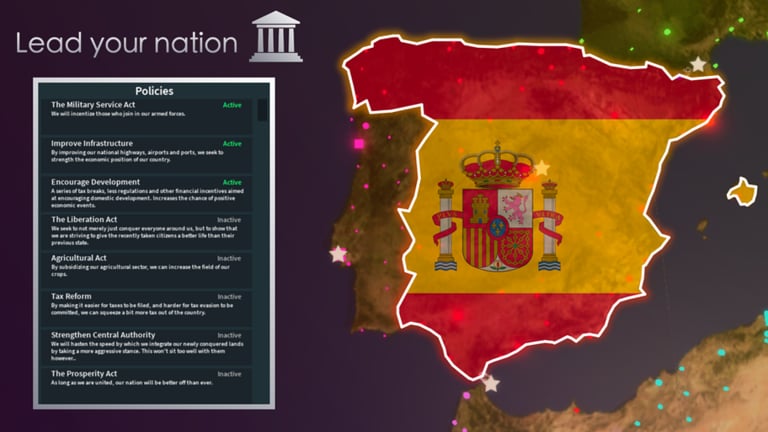
Ideology in Rise of Nations is more than flavor text. Hyperant’s Roblox grand strategy ties tax rates, factory output, manpower, justification speed, stability, and leader alignment to the path you adopt. This guide covers the seven ideologies — Non-Aligned, Liberalism, Democracy, Socialism, Communism, Nationalism, and Fascism — how State Doctrine laws work on the right wing, and how to change ideology through Liberation enforce-ideology wars, the Initiate Ideological Imposition project, and the Forced Regime Change modifier. Pair ideology picks with the Economy Guide, Military Guide, Projects Guide, and Getting Started. Patch timing lives on Updates.
How the ideology spectrum works
Most nations begin Non-Aligned. From there you climb a wing rather than teleporting across the map of politics:
- Neutral: Non-Aligned
- Center (tax path): Liberalism → Democracy
- Left (industry path): Socialism → Communism
- Right (expansion path): Nationalism → Fascism
You cannot jump Democracy straight into Fascism or Communism into Liberalism in one click. Plan political power, stability, and war timing so the climb does not bankrupt your opening factory race.
Non-Aligned
Non-Aligned is the blank slate. It grants no direct economic or military modifiers, which makes it flexible and weak at the same time. Stay Non-Aligned when you are still learning systems, when you want access to the Neutrality Act (see the Policies Guide), or when you are about to Liberation-flip into a target ideology without climbing every intermediate step the long way. Do not confuse “no modifiers” with “optimal forever” — mid-game powers usually want a tier-three identity.
Liberalism and Democracy (tax focus)
The center wing rewards population and tax. Liberalism is the stepping stone; Democracy is the high-tax end state many high-population cores prefer. Expect stronger tax income and tools that help manage unrest, with tradeoffs such as slower war justification and weaker factory multipliers compared with Communism. Democracy-style exclusive laws and policies (including Tax Reform style options) lean into peaceful income. Use Democracy when your Economy plan is electronics and consumer goods sold into a rich tax base rather than raw resource spam.
Socialism and Communism (factory focus)
The left wing is the industrial engine. Socialism opens the path; Communism is the factory and resource-output spike players chase on mineral-heavy starts. Communism trades tax income and corruption pressure for plant throughput and manpower-friendly wartime tools. Resource giants — large landmasses with phosphate, tungsten, oil, and similar deposits — convert Communism into absurd factory income once plants exist. Small barren starts that rely on tax often regret an early Communism flip. Budget anti-corruption and consumer goods before you celebrate the output multiplier.
Nationalism and Fascism (manpower and tempo)
The right wing accelerates expansion. Nationalism offers modest manpower, stability, and upkeep help without dramatic drawbacks. Fascism pushes justification speed, manpower gain, military upkeep relief, and multi-target justification tools that define aggressive metas. Fascism is not a free win button: unrest tools, ideology power, and political stability still matter, and exclusive policies like Expulsion Act style options change occupation math. Pair Fascism with a funded army from the Military Guide — cheap justifications on empty manpower still fail.
State Doctrine laws (not land doctrines)
Nationalism and Fascism unlock the State Doctrine law group. These are political laws, not a rename of land military doctrines such as Static Lines, Massed Attack, Specialization, or Manoeuvre Warfare.
Important options players discuss after the September 2025 State Doctrine pass:
- Classical — often the default when adopting Nationalism or Fascism; improves odds of ideology-aligned leaders (at a leader XP tradeoff in many rulesets).
- Stratocracy — a manpower-oriented State Doctrine law choice for Nationalism/Fascism. It is not “the old Generic land doctrine renamed.” If a guide mixes Stratocracy into the land doctrine list, discard that framing.
- Clerical — population growth, unrest reduction, and light war-exhaustion help, with religious-law constraints in some combinations.
Other State Doctrine flavors (for example Corporatist industrial lean or Falangism-style society tools) further specialize the right wing. Always read the in-game tooltip after patches — numbers move even when names stay.
Changing ideology: Liberation and projects
Natural ideology climb costs political power and stability management. Two faster routes matter in modern matches:
Liberation enforce ideology
Liberation (and related subjugation-style) wars can enforce ideology onto you when terms resolve in your favor against an ideologically distinct target. Historically, players used strongly aligned AI states as flip catalysts. Treat this as a tactical shortcut that still costs war time, development delay, and diplomatic heat — not a free lunch during your first factory wave.
Initiate Ideological Imposition and Forced Regime Change
The Projects system (May 2026 onward) added Initiate Ideological Imposition (expanded in June 2026). Completing it lets you switch ideologies with dramatic stability consequences and applies the Forced Regime Change national modifier for an extended period. Use it when you need a late mid-game identity swap without another Liberation war, and only after you understand the stability hit. Full project costs and capacity rules are covered in the Projects Guide.
Practical ideology plan
- Open Non-Aligned; secure factories and consumer goods first (Economy).
- Choose a wing that matches geography: tax cores → Democracy; resource plants → Communism; conquest tempo → Fascism.
- On Nationalism/Fascism, set State Doctrine deliberately — Classical for leaders, Stratocracy for manpower, Clerical when unrest and growth matter.
- Do not confuse State Doctrine with land doctrines; specialize military trees separately (Military).
- Use Liberation or Ideological Imposition only when the timing beats a slow natural climb.
- Recheck exclusive policies after each flip (Policies).
- Watch Updates after ideology and project balance weeks.
Ideology is the political multiplier on top of factories and armies. Pick the wing that funds your victory condition, then enforce it with laws, projects, and wars you can actually afford.
Frequently Asked Questions
Quick answers players search for every session.
What are the seven ideologies in Rise of Nations?
Non-Aligned, Liberalism, Democracy, Socialism, Communism, Nationalism, and Fascism. Most starts begin Non-Aligned and climb a wing toward a tier-three identity.
Should I pick Democracy or Communism for money?
Democracy favors tax income on high-population cores. Communism favors factory and resource output on resource-rich starts. Match the wing to your geography and plant plan.
Is Stratocracy a land military doctrine?
No. Stratocracy is a State Doctrine law option for Nationalism and Fascism that leans into manpower. Land doctrines remain Static Lines, Massed Attack, Specialization, and Manoeuvre Warfare.
How do I change ideology quickly?
Climb naturally with political power, enforce ideology through Liberation-style wars, or complete the Initiate Ideological Imposition project and accept Forced Regime Change consequences.
What is Classical State Doctrine?
Classical is a State Doctrine law commonly defaulted when adopting Nationalism or Fascism. It improves chances of ideology-aligned leaders compared with other wings.